




Tanzania is holding its general elections today, Wednesday, October 29, 2025. Citizens are casting their votes to choose the next president, members of parliament, and local government representatives. Over 37 million registered voters are expected to participate in what is seen as one of the country’s most significant elections in recent years.
Incumbent President Samia Suluhu Hassan, representing the ruling party Chama cha Mapinduzi (CCM), is seeking her first full term in office after assuming power in 2021 following the death of former president John Magufuli. Polling stations opened at 7 a.m. and are set to close at 4 p.m., after which vote counting will begin.
Political Climate and Concerns
The election is taking place amid widespread concerns about political freedom, media restrictions, and the fairness of the electoral process. Several opposition figures have faced legal challenges, disqualifications, or imprisonment.
Human rights groups have raised alarms over reports of arbitrary arrests, disappearances, and intimidation of opposition supporters during the campaign period.
Internet disruptions and social media slowdowns have also been reported across parts of the country, leading to fears of restricted access to election information.
Analysts note that voter enthusiasm appears lower compared to previous elections, with many citizens expressing skepticism about whether the outcome will reflect their true will.
Key Issues at Stake
For President Samia Suluhu Hassan and CCM, today’s vote represents a chance to reinforce their decades-long hold on power. The ruling party has governed Tanzania continuously since independence in 1961, making it one of the longest-ruling political parties in Africa.
For opposition parties and civil society, the election is seen as a test of whether Tanzania can restore credibility to its democratic institutions after years of shrinking political space.
For ordinary citizens, the results will influence issues such as economic reforms, youth employment, cost of living, and access to essential services such as healthcare and education.
Election Day Events
Reports from several regions indicated that voting began smoothly in most polling stations, though some areas experienced delays in opening or shortages of materials.
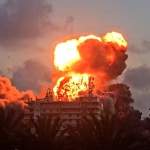
In the commercial capital, Dar es Salaam, tensions flared as protests erupted in several neighborhoods, leading to clashes between demonstrators and police. Authorities have imposed a night-time curfew in parts of the city to maintain order.
Despite these incidents, the National Electoral Commission has assured citizens that the voting process remains secure and transparent.
Observation and Oversight
Election observers from the East African Community (EAC) and other regional bodies have been deployed to monitor the voting and counting process. Their presence aims to ensure fairness, transparency, and adherence to democratic principles.
However, several independent observers and media organizations have reported restrictions on access to certain polling centers and challenges in obtaining accreditation.

What to Watch Next
- Voter Turnout: Analysts are closely watching participation rates, which will indicate public confidence in the process.
- Results Announcement: The Electoral Commission has up to seven days to release official results.
- Post-Election Reactions: The reaction of opposition parties and citizens will be crucial in determining whether the election outcome is accepted peacefully.
- Stability and Governance: The conduct of the election and its aftermath will shape Tanzania’s democratic reputation and influence relations with international partners and investors.